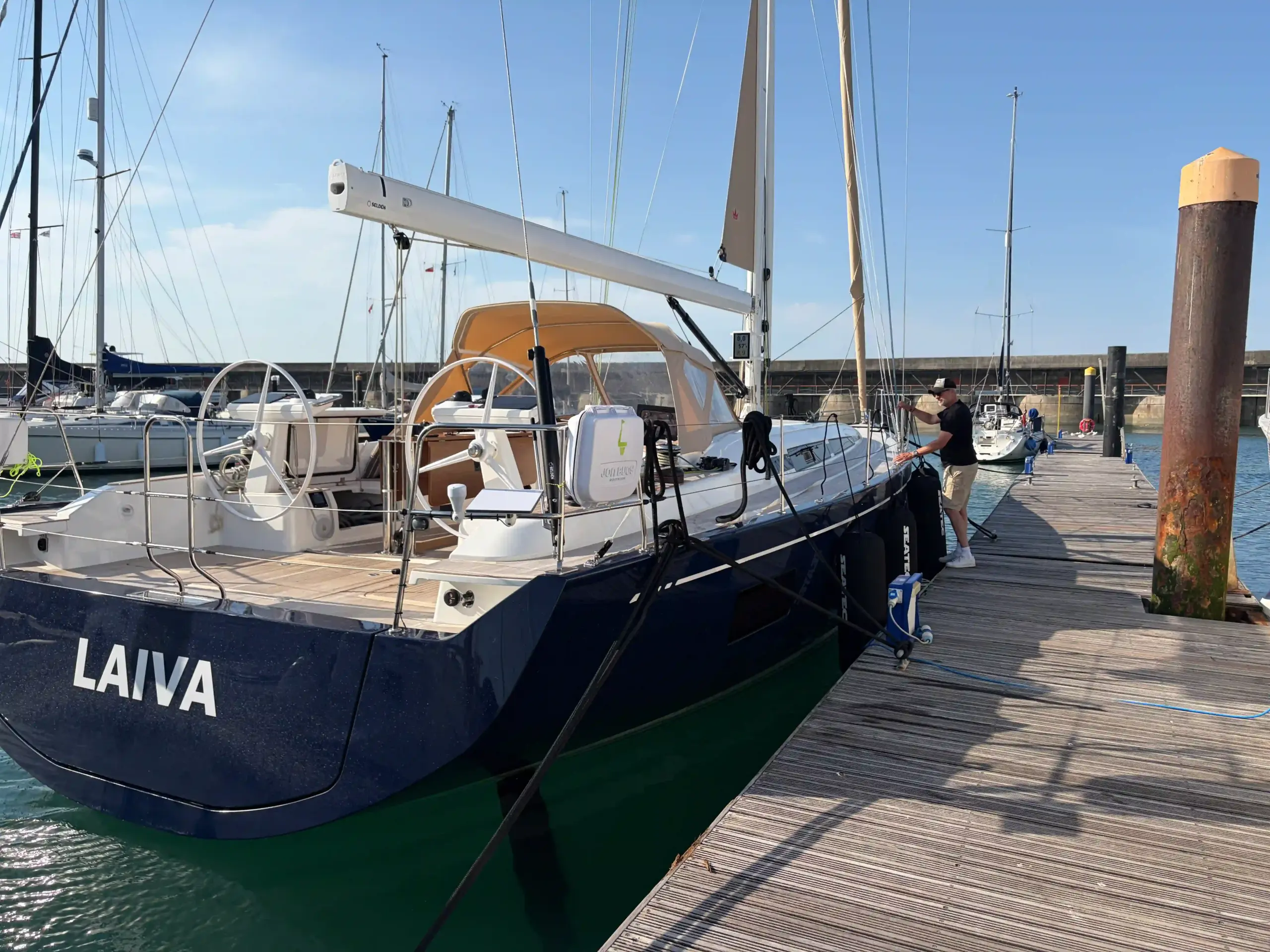
Aboard a Hallberg-Rassy 49 from La Spezia, Italy, to Kefalonia, Greece

By Rainer Holtorff
Ischia, Italy, March 31
My advice to pay attention to the overall weather pattern was disregarded in favor of a fixed schedule, and we were in for quite a shaking.
But first things first:
I traveled to La Spezia a few days before Easter to accompany a delivery passage bound for Kuşadası as far as western Greece. The well-maintained Hallberg-Rassy 49, a flush-deck design by Ole Enderlein, had been sold. The paperwork was complete, and it was time to hand over the yacht. Representing the Italian side were Andrea, the previous owner’s son, and Davide, a family friend who also knew the boat. There was a lot of equipment on board: a 140 hp turbo diesel, a Kohler generator, six electric winches, an electric roller-furling system, electric toilets, three chartplotters, a hydraulic autopilot, an automatic passerelle, a freezer, a hydraulic bow thruster, a washing machine, various alternators, different voltage systems, an inverter, new North 3DL sails, a staysail, a gennaker and much more. We tested everything, which took more than half a day.
Afterward, as we stood on the dock, I noticed that Andrea’s face had turned red. I asked whether it was difficult for him to say goodbye to their boat. Then it all came pouring out:
“I was born on her, I grew up on her, practically…”
He meant his, their Cinderella, who was the same age as he was and whom he was now probably seeing for the very last time, because his father had sold her, had had to sell her, and three Germans would soon be sailing her away.
And so we did. The following midday, we cast off to tackle the first 450 nautical miles toward Messina. Our problem was a strong southeasterly wind and 3 m waves, so a direct route was out of the question. Our only chance, we felt, was to sail a long tack toward Corsica and Sardinia and hope for more favorable winds there.
From the first movements of the helm, I realized that this yacht handled like a tanker. No wonder: in addition to 1,400 liters of water and 700 liters of diesel, we had taken aboard a great deal of equipment previously stored in a shed in La Spezia.
As we left the bay, a 2 m swell rolled toward us from the southwest. Somehow I had imagined that, with her sheer weight, this boat would be a kind of floating fortress. Instead, I found the 23-ton Rassy bucking as we motor-sailed onward.
That evening we passed the island of Gorgona and reached the Corsica Channel, between Capraia and Cap Corse, around midnight. With no wind, we headed south in the morning along Corsica’s snow-covered peaks, passed the Strait of Bonifacio in the early afternoon, with the wind whistling out of it as usual, and entered Olbia on Sardinia in daylight to refuel. After all, we had motored for 30 hours. I hoped we would stop there, but Lothar, the owner, was determined to use the weather window before a storm swept across the Tyrrhenian Sea over the weekend. As skipper, I could raise no compelling objections, so we agreed on a manageable route east, across to the Italian mainland, about 200 nautical miles away. I announced Capri as our distant, shimmering destination, and Lothar responded with an imitation of a fisherman’s song. Before long we had slipped our lines, having spent less than an hour on Sardinia.
As the outlines of the mountains disappeared against the glowing red sky, we were finally able to switch off the engine and head east on a beam reach under a full moon.
By morning the wind was once again on the nose and growing stronger. Wilfried, our third crew member, steered by hand because the autopilot could no longer hold its course. My attempts to remedy this, reefing the mainsail and genoa and resetting the entire system, were unsuccessful. It was now clear that we would be steering by hand for the final 120 nautical miles to the Campanian Archipelago. But that was not all: next the genoa sagged; it must have torn at the head. We brought the sail down onto the deck and lashed it in place.
Somewhat battered, we reached Ischia in the middle of the night, 31 hours after leaving Olbia. We had sailed almost 400 nautical miles in two and a half days, mostly against the wind. That was 100 miles more than the distance from La Spezia to Ischia in favorable winds. But who has time these days to wait in port until the right wind comes along? Somehow, people in the past had the advantage over us there.
20 nautical miles southeast of the mainland, off the Gulf of Salerno,
- April
Easter on Ischia had been entirely unplanned. We found ourselves among Romans and Neapolitans spending their holidays there, each with their own car, making the coastal road noisy and dangerous. Apart from our Cinderella, I saw little: the café on the square, a path up to the closed “Hotel Paradiso,” and a glimpse of Ischia’s harbor, reached in a minibus packed with people. But we received a friendly welcome. The Casamicciola harbormaster even waived half a night’s charge.
Lothar recently had a very different experience with another boat in the town of Symi in the Aegean. He has just told the story on deck:
When he and Doro tried to weigh anchor, it had become caught on another chain on the seabed. They could see that the whole tangle was attached to a stock anchor, but they could not free it without help. Across from the anchorage stood a bakery. The baker, who was also a recreational diver, offered to untangle the anchor chains underwater. They accepted.
After a while, the man arrived in a bright red powerboat, accompanied by his son, who was similarly rotund. The baker struggled to squeeze into his wetsuit and first had to oil himself up. When he finally dived down, his son held the dinghy in position. Before long, the anchor was free. The baker proudly presented the stock anchor and its chain. As Lothar handed over the agreed sum of one hundred euros, it occurred to him that he could take the stock anchor too. After all, he had paid to recover the troublesome object. It quickly became clear that this did not suit the baker. He insisted that the anchor should stay where it was. Upset by this, Dorothea went to the harbor police officer and told him what had happened. But the officer merely shrugged and made it clear that such things were none of his concern. Lothar and his wife therefore left Symi without the stock anchor, but not without a lesson in harbor economics.
On Ischia, too, the sum of one hundred euros came up, for repairing the torn webbing at the head of the genoa. For that, however, three strong islanders collected the heavy headsail on Holy Saturday and delivered it back to the yacht, properly repaired, at noon sharp on Easter Sunday. At the same time, the story of Jesus’s resurrection was being performed for the entire community in Casamicciola’s piazza, complete with incense and firecrackers. By then, the forecast storm was whistling across the Campanian Archipelago. The ferries had stopped running. We spent the rest of the day on a maintenance marathon: we fixed the anchor securing arrangement, checked the engine, cleared the log, got the hydraulic autopilot working again, corrected the NMEA system connecting the instruments, hauled me up the mast and more.
Meanwhile, I corresponded with the previous owners to find out a few missing details about the boat.
To top it all off, the water pump failed that evening and kept us busy for another two hours. Only then, exhausted by all the technical trouble, could we say:
“We’re ready to put to sea again!”
Fishing harbor of Bagnara Calabra, Calabria, April 4
If someone had told us yesterday morning that we would not reach the Strait of Messina today, we would have thought them mad. Now we would call them an experienced sailor. Here is why.
The night on passage from the Campanian Archipelago to the Strait of Messina had been calm. The sea had settled, eventually becoming completely smooth. At sunrise, still 50 nautical miles north of the strait, a headwind set in. At first there were only ripples, then whitecaps, and later the waves grew to two meters. By midday they were already three meters high. Whenever Cinderella’s hull met a breaking wave, there was a bang. Spray flew, and the impacts became more frequent. We had seen the forecasts. We knew to expect headwinds of up to 20 knots north of Messina, stronger to the west than near the mainland. For that reason, we had taken an easterly arc the previous evening, but had resumed a direct course when the wind died altogether.
Today the barometer did not move by a single millibar. The sky remained deep blue. Nevertheless, 20 nautical miles from the strait, gusts of 48 knots came at us. That is storm force, but we did not take it seriously: we trusted the heavy boat and the forecasts. Surely there could be no real problem, just a few stray gusts whistling out of the strait and somehow finding their way to us. We were looking forward to two days in Messina, where we planned to wait for the north wind that would carry us across to Greece.
Target fixation is the phenomenon that young airline pilots are trained to overcome, so they do not cling to plans at all costs as conditions deteriorate and put people in danger.
Apparently we too had succumbed to target fixation. Even when water began pouring through the forward hatches because the seals could no longer withstand the pressure of waves flooding the deck, we merely moved the mattresses aside, put down a few towels and switched on the bilge pump. We stayed on course.
Only 10 nautical miles from the strait did it dawn on me that the day could end badly if we did not read the signs. No persuasion was needed: much as they would have liked to visit Messina, my crewmates immediately agreed that it would be better to seek shelter on the Calabrian coast.
According to the chart, there were not many options. No major town, no headland: we were approaching a coast with no shelter at all. Six nautical miles away lay Gioia Tauro, a container port whose cranes we could already see. The chart also showed a basin for smaller boats. It was not an inviting prospect, but with the wind showing no signs of easing, we no longer cared.
We followed a freighter into the outer harbor and found our basin behind a rock breakwater, surrounded by buildings reminiscent of East German border facilities. One glance told us there was no point trying to berth here. It was too narrow, and all the berths were occupied by motorboats.
We went back out into the rolling sea. When you cannot find a place to tie up, despite wanting to, a passage can quickly become an ordeal.
The wind continued to whistle out of the Strait of Messina unabated. Only close to shore were we spared. We motored farther down the coast. Our next hope, the harbor of Palmi, was dashed when it came into view. It too was too narrow, and exposed to the wind, with waves running into it; an approach would have been too risky. A group of rocks offshore, which might have made a useful anchorage in calm weather, offered no protection either.
We began to consider the possibility that we would find nothing more along the instep of the Italian boot. A glance at the chart told us that the next safe harbor was 30 nautical miles to leeward, beyond Cape Vaticano.
Thirty nautical miles we would then have to sail back. It seemed that was what it would come to, but we were not ready to give up. We continued south.
We passed the concrete breakwater of the next harbor, but had little hope of finding suitable shelter, especially since we could not see a single mast. Wilfried insisted that we take a look inside anyway.
As we rounded the corner, it grew warm and the water was smooth. Fishing boats lay at mooring buoys, sterns toward the pier. Inland, mountains rose up, green with vegetation to their summits. Groups of men stood on the shore, others were fishing, and people out for exercise walked along the breakwater. A small road coming down from a mountain ended here. We would have been happy to tie up alongside a fishing boat. We asked someone standing on deck whether that was possible, but he simply pointed to the other corner of the harbor. There was a pier painted blue. As we drew closer, we realized it was the harbor fuel dock, with the pumps covered by tarpaulins. We tied up and breathed a sigh of relief. Thirty-one hours after leaving Ischia, we were securely moored again, and it was completely still.
The town to which this harbor belonged was called Bagnara Calabra. I expected someone to come and chase us away with a great commotion; I had experienced that in Italy before. But nobody came, not even after two hours. After our little odyssey, it felt almost like a miracle.
I went out to buy some fresh food. There was a lot of stuff lying around the harbor: piles of uncollected rubbish, pools of oil and broken boats that nobody needed anymore. The route into town crossed a hill topped by an Aragonese defensive tower.
Old Bagnara Calabra lies on the hillside. The newer town has grown across the flat land between the mountains and the beach. There, too, are the concrete remains of failed building projects, shacks with torn windows and rubbish at every turn. People with plenty of time on their hands stood or sat along the waterfront road in the afternoon sun: in pairs and threes, whole families, but also in groups separated by gender. I strolled past them, and they watched me with dark eyes. The word ’Ndrangheta came to mind, perhaps unfairly, but this really did not look like a respectable middle-class neighborhood. Nobody I spoke to answered in English. Apparently no foreigners came here. I felt as though I had landed in the suburban ghetto of a metropolis, except that there was no metropolis for miles around.
At night, alone in the pitch-dark fishing harbor. It was absolutely silent. I wondered whether the ’Ndrangheta might be interested in foreign sailors. Was that a sound? Those were footsteps! I turned over and went back to sleep.
The next morning, the Guardia Costiera appeared at our stern in the form of a small man in his sixties, the official-in-charge type, and his young female colleague, both in uniform. Lothar began chatting with them. I was not sure he understood the seriousness of the situation: if they threw us out now, things would become difficult again. The weather had not changed, and the wind was still whistling out of the Stretto di Messina. The officer made it clear that this was no berth for sailboats and that we had to leave immediately; this harbor had berths only for fishermen!!
I stammered something about our struggle with the elements and the shelter we had desperately needed, and also hinted at technical problems. We were granted a reprieve until the following day: “Domani!!”
We stayed in Bagnara for two days. I liked it there: the silence and the little jungle behind the harbor, the unvarnished glimpse into the world of the Mezzogiorno. We would never have called at this Calabrian backwater voluntarily. The wind had blown us in. That is sailing for you: “It brings you to places,” as the English say.
Kefalonia, April 7–8
When the southeasterly eased, we cast off. The sea north of Messina had finally calmed down. We passed the anchorage off Scilla and made our way into the long, narrow strait.
During the morning, we tied up in Messina, where we planned to refuel and take a fourth crew member aboard that evening. When we learned that there was no fuel station in the harbor, we had to move across to Reggio di Calabria. I was a little nervous about cruising between Scylla and Charybdis: sea monsters have swallowed whole ships here, and even if you dismiss ancient legends as sailors’ tales, the strait can quickly show you how small you are. Our peace was indeed short-lived: the north wind strengthened, and as I turned the Hallberg-Rassy into the narrow gap at the fuel dock in Reggio, I already had to be extremely careful not to be blown off. A younger man and a wizened older man took our lines. Neither had ever heard of the importance of a spring line in strong winds. We had already started filling up with diesel when the older man pulled me ashore and led me to the trunk of an old taxi. He pressed a bottle of wine into my hand as a gift and urged me to buy a few rounds of pecorino from him. Since I did not know what connection he had to the fuel attendant, and we hoped to be allowed to stay until our fourth crew member arrived, I accepted the offer. Saviero, as the taxi driver was called, turned out to be a kind of mobile yacht service. He proudly showed me photocopies of entries about him in British cruising guides. He offered to help with any conceivable request and secured my promise to call him later if we wanted to stock up on food. Then he drove off, waving. That is how things work in the Mezzogiorno: the boundaries somehow blur, and fuel stations, cheese merchants and yacht services become one.
As we planned to set off that evening on the 250-nautical-mile passage to Greece, we got some sleep beforehand. Later, I took a walk around Reggio, a city ravaged by wars, earthquakes and tsunamis. I would have liked to see more; I can become absorbed in places like this, but I had no time here. I was soon back on board, laying out jacklines with the others and bending on the staysail at dusk.
After our fourth crew member, Dirk, arrived, a strong north wind pushed us out of the strait and into the night. It left us again in the lee of Calabria, only to return with even greater force beyond Cape Spartivento. I found this worrying, because the strong wind was not supposed to arrive until the following day, when we would be in the middle of the Ionian Sea. In fact, the wind eased again; it must have been one last greeting from Calabria, whistling around a mountain range.
The night went according to plan. Thomas, our weather adviser, who had been advising us from Germany since La Spezia, wrote via satellite that we should make sure to rest today, because the coming night would be demanding.
When conditions are calm on a long passage, it is wonderful. You sleep, keep watch, cook and eat: life follows a watch schedule that, provided the crew is large enough, leaves time for all sorts of things. Even so, I always try to impress on people how important it is to rest; things can change quickly. The weather can turn, equipment can malfunction, or someone can be incapacitated. Suddenly you are called upon, and you need reserves to draw on. I probably already sensed that we would still need ours on this passage.
It was still calm in the early afternoon of the following day, with Reggio 100 nautical miles astern. Suddenly we could see the swell growing higher, although the wind strength had not changed.
Only a short while earlier, Lothar had claimed that we could sail to Greece without reefing. I had not contradicted him, merely thinking: Let the wind answer that. Soon it was howling and whistling through the rigging. The heavy, short-keel boat rolled from side to side like a porch swing. Everyone on board knew we needed to shorten sail, so we went straight to the second reef. I thought our plan to maintain our latitude all the way to Kefalonia despite the strong wind on the beam was bold. Thomas had even predicted that we would not manage it, that the north wind would push us all the way south of the Peloponnese.
Soon waves were breaking over the boat. At least no more water was coming through the forward hatch; it had now been sealed. What began to wear us down was the heavy rolling and the spray constantly coming down on us.
At dusk, a tern landed on a wall light in the saloon. It moved with the rolling boat as though mounted on gimbals. Every attempt to encourage it to fly away was in vain; it was far too unpleasant outside.
The wind grew stronger. More and more often, the hydraulic autopilot gave a few shrill beeps and simply cut out. When we examined the drive, we found that it was in danger of overheating. We switched it off and began steering by hand. Even with the second reef in, we were still making plenty of speed. That may be fine in the Volvo Ocean Race with a crew of ten, but it was less so for us, with one person incapacitated by seasickness and the remaining three standing solo watches. The wind had risen above 40 knots, and steering required constant concentration.
Around 9:00 PM I had had enough. In an operation that was already not without danger in the rough seas, Wilfried and I pulled down the mainsail. I thought back to the handover of the boat a few days earlier: we had hoisted the mainsail with the previous owners in calm conditions at Porto Lotti to test it. When I noticed that the boat had no third reef, Andrea and Davide replied in unison that they had only ever sailed Cinderella with the first reef at most, and even then only in winds above 28 knots. Otherwise, they said, there was no need for a reef at all, certainly not a third one, never. I had found that strange at the time. A cruising yacht without a third reef? Could such a boat be seaworthy offshore?
We received an update from Thomas via satellite. The worst should be over by early morning, he wrote. Around midnight, however, the wind picked up again. The sea grew rougher. When Lothar let go for a moment, he fell across the saloon and struck his head against the wooden post beside the galley. It looked brutal, but Lothar merely said:
“Nothing happened, I think!”
It was frightening to imagine having to send a distress call here in such conditions. I made another mental note for future passages: before heavy weather, everyone must promise to move around the boat with the utmost care.
A few years earlier, after the helm station was modified, Cinderella’s compass had been mounted by the companionway. It was a tiny model, and the heading was barely visible from the wheel. I therefore steered using the bearing of the North Star relative to the boat, with an occasional check of the chartplotter. The wind was still whistling at over 40 knots. Even so, we did not bear away, stubbornly holding our course east.
Wilfried came to relieve me. He was not feeling well, but he took up his watch. Lothar, too, who had no proper foul-weather gear with him, only a kind of rain jacket and a cap that must have been very chilly in all the wind and spray, faithfully stood his watches. Conditions were rough, but we worked hand in hand.
More than 90 nautical miles from Kefalonia, I spotted the lights of a large vessel. I could not tell where my opponent was heading, but after a while it became clear that the bearing was constant, which meant a risk of collision. I took comfort in the thought that the other vessel must still be far away; it had only just come into view.
But when I looked up again a few minutes later, it already seemed much closer. I even had the impression that I now had to look up slightly, as though it were already so close that I was below its navigation lights. All I could really see was a glaring yellow light. A huge trawler? I became nervous, and was already somewhat dazed from lack of sleep and the constant rolling. I wondered whether I should have acted already. Why was there no AIS signal on the chartplotter? Could a vessel so huge that I had to look up at it really not be transmitting an AIS signal?
The problem with a solo watch in rough seas without an autopilot is that you simply cannot leave the helm to check the radar, for example. Eventually my opponent’s navigation light was so high that I must have been diagonally below it. Surely only a last-minute maneuver could help now. I was about to make it when it dawned on me what this stupid ship must be called: her name was Jupiter. It had risen in the east.
Relieved, I steered the boat through mountains and valleys of water. The wind had not eased. It was still night. The movements at the helm were monotonous. It looked as though we could hold our course to Kefalonia. Despite the roaring and howling, I was completely calm and felt at ease, in the heart of the sea.