North in Late Autumn – From Lagos to Hamburg in a Dehler 47
Friday, October 23 Underway: Bay of Sines, Portugal.
The crew are sitting in the cockpit, talking. Like all crews setting out on a passage, they cannot or do not want to sleep.
Alexis just said he needed to soak up some daylight, since we were heading into fog and darkness. Fibre, pronounced “Fiber,” added that there were only 11 hours of daylight left, but 13 hours of darkness, and the nights were getting longer. What can I say? They are right.
We are on our way to Hamburg. The five of us set off hours ago, leaving Lagos, the tourist town on the Algarve. We are probably the only yacht heading north at this time of year. It is already late October.
Roland, our senior crew member, has taped a map to the wall in the saloon. He always does that, he says. The map shows the entire route: the Costa de la Muerte, the Bay of Biscay, the English Channel and the North Sea. 1,600 nautical miles.
For now, I try not to look at it too closely. The route commands respect even in summer. But now the real low-pressure systems are rolling in. We shall see how we manage.
Recently, I was in Heiligenhafen and read a saying on a wall:
“The waves and wind belong to God. But the sails and the helm with which you reach harbor are yours.”
I am not a religious man, but the saying inspired a certain awe in me, so I recited it to the crew yesterday in Lagos, at our farewell dinner with the owner. All I got was shrugs and awkward silence.
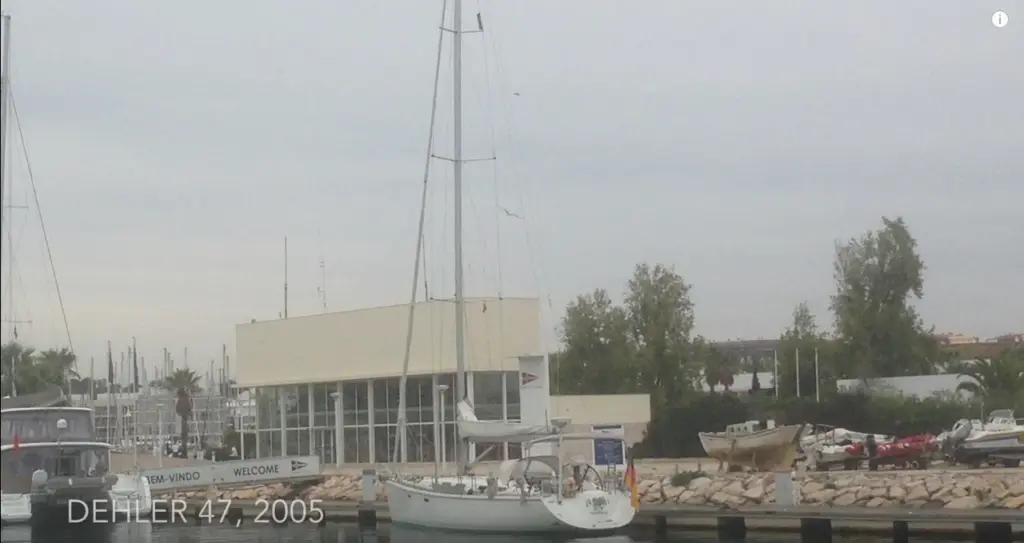
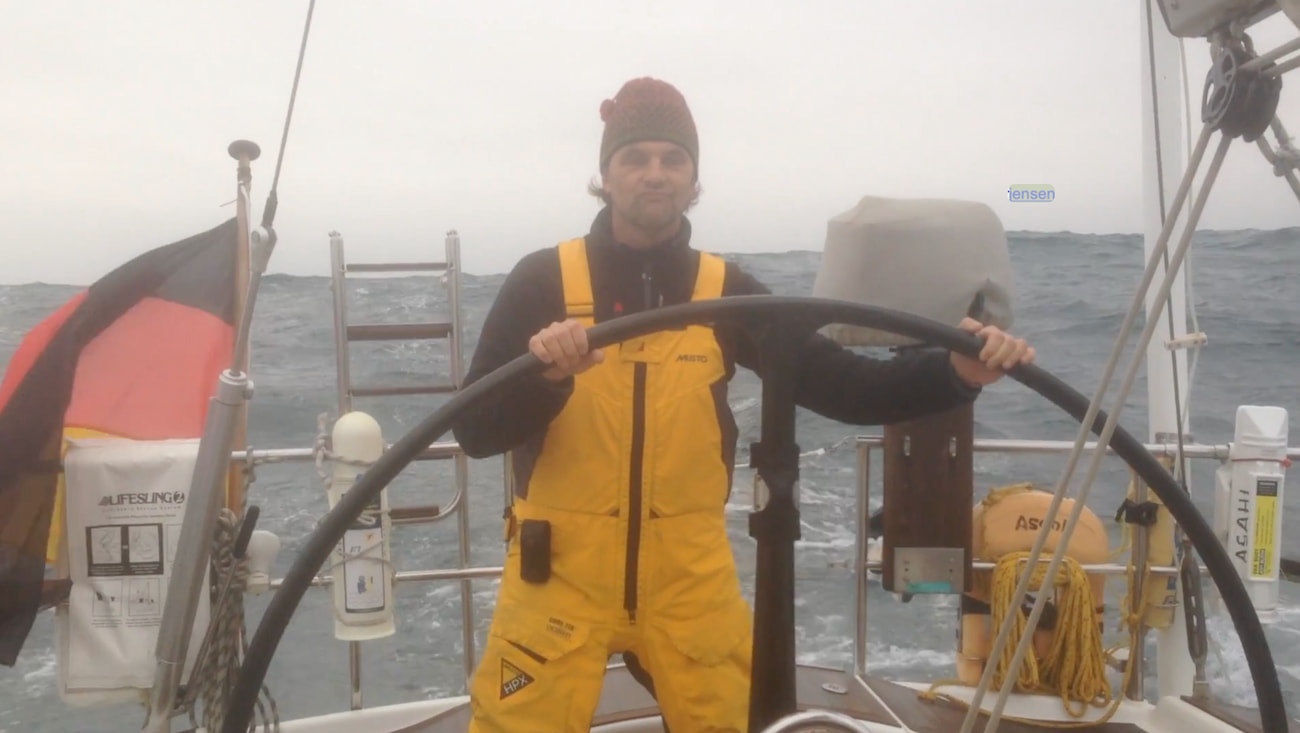
The helm with which we hope to reach harbor belongs to a Dehler 47. The good lady spent six years sailing the Caribbean, from north to south. She hardly missed a corner. She particularly enjoyed her time “with Chávez,” the owner told us. Now it is time to give her a bit of a refit, service the electrical contacts and replace some rigging and sails, so she is going into the yard in her home port of Hamburg.
Three hours ago, we passed Cape São Vicente, the corner at the very bottom left of the Iberian Peninsula.
The first night is almost upon us. The watch schedule is already on the wall. I have assigned two-hour watches and will remain on standby myself. We shall see how it goes…
- October 7:24 AM
At last the wind has picked up, a breeze from the east. But where is the daylight? It is already half past seven, yet the only reddish glow here is from Lisbon, 50 kilometers away. We know that a fairly strong northerly is expected this evening, so we will probably have to stop in Cascais. We also need to get the heating working for the latitudes ahead.
- October 8:55 AM
Based on new weather data, we have just decided to continue sailing north along the Costa de la Muerte rather than head for Cascais, even though the harbor was already in sight.
- October 1:30 PM, another 20 miles until Peniche is abeam.
I find it quite difficult to decide whether to enter a harbor or carry on along the “Costa de la Muerte.” Especially since the tragic accident involving Meri Tuuli off Figueira da Foz. The crew of that yacht had relatively little idea of the danger when a breaking wave overwhelmed them on the harbor approach, causing the boat to capsize and eventually run aground.
Unfortunately, along this coast the authorities “close” harbors in certain weather conditions because the waves piling up outside become too steep. The paradox is that you may no longer be able to find shelter when you need it most. As there are relatively few harbors along the Iberian Atlantic coast anyway, you have to weigh carefully whether to pass up a safe approach in order to make further progress.
In our case, the question was whether to put in at Peniche or continue. We have just decided to sail at least as far as the Rio Douro at Porto, and possibly even as far as the approach to Vigo.
- October 10:18 AM 20 nautical miles off Porto
There is hardly any wind left, but the northwesterly swell is giving us quite a ride.
I have no idea what it would be like to enter Leixões or Porto now—we are not going to find out. Fortunately, we do not have to. I have no desire to see this swell, which is already impressive in 50 meters of water, in 15 meters, the depth at the entrance to Leixões. I think the crew feel the same way.
We will carry on to the Ria de Vigo and enter around midnight.
If all goes well. Unfortunately, there are no other options along this coast before then…
That is why it is called the “Coast of Death.” For someone like me, who grew up on the Baltic Sea, where there is a sheltered harbor every few miles, it is quite inhospitable here. So, then: another 70 miles…
Sunday, October 25 12:27 PM
I have just dug out the sextant that I have been kindly allowed to use. It took a while to bring the lower limb of the sun down to the horizon. My first noon latitude on this boat was 41 degrees and 29 minutes. The GPS showed 42 degrees and 6 minutes at the time. A difference of 12 nautical miles. That is not sooo bad…
Tuesday, October 27 11:59 PM
Already 48 hours in Vigo. We entered this harbor just before midnight the day before yesterday. And I am not quite sure when we will be able to leave again…
This is what can happen when you head north on the North Atlantic at the end of October. At least another boat has turned up yesterday, heading in the same direction, more specifically to Falmouth. We and the two Englishmen are having our patience tested for now, as several weather systems are currently overlapping, creating cross seas with waves up to 8 meters high. The competitors in the Transat Jacques Vabre, who set off from Le Havre a few days ago, have sailed straight into this storm, and some now have to be rescued. Well, fortunately we are only cruising sailors. So let us have a look around Vigo. It is pouring with rain, though…
Sunday, November 1, 3:08 AM.
Just a few more miles to A Coruña. We spent Halloween night at sea, and the ship’s spirit did not appear.
We set off this morning after having to wait five whole days to continue. I do not want to complain: the people of Vigo welcomed us warmly, and I must say the city is well worth a visit.
Nevertheless, we also know that snow will soon begin to fall on the North German Plain. With that in mind, we would have liked to move on sooner—but it was simply not possible.
Even this morning, when we wanted to leave, there was still a “Force 8” warning at Cape Finisterre. “Sea State: Rough.” The English yacht being delivered by Falmouth Yacht Service went out anyway.
We hesitated at first, because the waves were forecast to reach 7 meters.
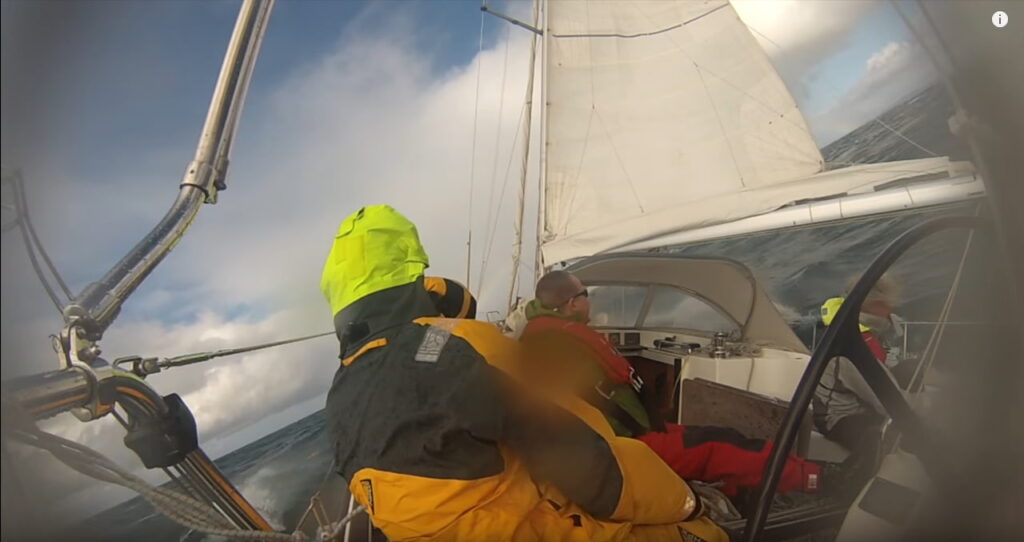
Then we decided to “stick our noses out.” As we approached the Canal Norte, one of the exits from the Ria de Vigo, the wind instrument showed more than 30 knots even in the lee of the Illas Cíes. We hesitated briefly and were on the verge of turning back, moving to Baiona and going to a café, but then we headed out after all. Our sail plan: the mainsail with two reefs and a tiny amount of genoa. We were on a broad reach. In 50 meters of water, we marveled at the great waves rolling toward us from the northwest. Now and then a wave broke, its crest glowing green in the sunlight from the south. It was exciting, but also immensely liberating to be underway again.
The tension eased when we realized that the situation was stable. We settled into the watch schedule.
In the late afternoon, we rounded Cape Finisterre at a distance of about 5 miles. A large red rescue tug that had left Vigo shortly before us sailed alongside us at the cape, as if it wanted to protect us. In fact, the wind and waves picked up again right at the cape. When night fell and we came into the lee of the land, conditions eased.
The latest forecast called for northerly winds of force 5–6 for the next 24 hours. Nobody was particularly keen on sailing without making progress, so we put in at A Coruña.
Monday, November 2 07:25 UTC
The next day we put to sea again. Crossing the Bay of Biscay was next on the agenda. The weather suggested that, in a little over two days, we would not need to stop in Brest but could head straight for the English Channel.
About 50 miles north of the Galician coast, we suddenly noticed water inside the boat. There was quite a lot of it, sloshing back and forth beneath the floorboards. The automatic bilge pump was pumping it out, but more water kept coming in. At first, the cause was a complete mystery. We initially thought it might be coming from the rudder shaft, which was truly worrying. Then, just as I was about to turn toward Gijón, we discovered that it was coming from the freshwater system. A hose clamp had come loose, allowing some of the water in the tank to flood into the bilge.
Otherwise, the crossing of the Bay of Biscay was rather uneventful. We had to motor for a good part of the way. The wind did not return until we were 90 miles off the French coast.
On Wednesday, November 4, we reached the Iroise Sea, west of Brest.
As we had no new weather data, I radioed a Danish freighter crossing our course. The officer on watch reported that there were no strong wind warnings. Based on this information, we decided to pass Brest and sail on into the English Channel.
We were all the more surprised when, with Île d’Ouessant abeam, the wind suddenly strengthened. We were now also able to obtain our own weather data by mobile phone—and sure enough, there were storm depressions nearby. Moreover, the French coast guard was by now issuing radio warnings at least ten times an hour of
“mer agitée forte.” To this day, I wonder what the Dane could have been looking at—it certainly cannot have been current weather charts.
By then, however, it was too late to head for Brest. When darkness fell, we were already too far north and would have had to beat back against wind and tide. We could only look ahead. Beyond Ouessant, we changed course to the east and sailed into the lee of northern Brittany.
At dawn, we moored in the small town of Roscoff.
Saturday, November 7
At last we are leaving Roscoff. A storm depression has kept us pinned down here for more than two days. The wind direction suited our plans, but I could not justify sailing around Cap de La Hague, the northwestern corner of Normandy, in southwesterlies of over 40 knots and a heavy Atlantic swell. Not far from there are some of the strongest tidal currents in the world. That is no place to be in a storm. And if you do find yourself there, better as crew than as skipper…
It was to be expected that a passage at this time of year would involve time spent in port. Seafaring has always involved waiting. You simply have to make use of the time. We visited the Breton town of Morlaix and wandered around Roscoff in the wind and rain, but in the end it was still an enforced stop. Now, at last, we are about to continue…
Monday, November 9, Cherbourg, 14:00 UTC
We sailed from Roscoff in the afternoon, heading toward Guernsey and Cap de La Hague.
A carefully calculated weather window between two fronts. On the way to the cape, the pressure jumped to 1,027 hectopascals and there was a brief lull—then the southerly wind from a new low-pressure system set in. We sailed around the cape at 11 knots and reached Cherbourg in the morning, as the southwesterly strengthened to near gale force.
We briefly considered waiting for just one tide here and continuing toward Dover, but abandoned the idea: the sea in the Strait and off the Belgian coast would have been too rough. We must also remember that we are underway mostly in darkness. Today, a day later, it is still blowing force 6–7 here. We are nevertheless about to cast off and hope for moderate conditions when things get tight near Calais tomorrow. We expect to need about 24–27 hours to get there. The plan is to sail through at least as far as Amsterdam, if not all the way to Cuxhaven.
Postscript:
We left Cherbourg. Just beyond the harbor entrance, we were astonished when the boom touched the water as we sailed on a broad reach through the waves.
For a while we raced east at over 10 knots. Shortly before dark, we put the second reef in the mainsail. Eventually, we were sailing under jib alone, which we can set on a separate stay.
We no longer used the genoa. Who trusts a roller-furling sail in strong winds?
It was a lively night in southwesterly force 6–8. There is little in the logbook. Typical of such a situation. You are busy with things other than writing. For example, compensating for the boat’s rolling motion. Or conserving your strength because you know you may need it later.
We sailed east for a while in southwesterly force 6–8 and waves of 3–4 meters, until we could make out the glow in the sky above Le Havre. Then we went onto starboard tack and headed up toward Calais.
At around 9:00 AM, we were 30 miles from the Dover Strait. There, the state of the tide is crucial: whether the water is running against you or with you.
At noon, with the current in our favor, we reached the narrowest part of the Strait. Cap Gris-Nez was gray and overcast; there was no sign of the White Cliffs on the English side. We thought the worst was already behind us, but—contrary to the forecast—the southwesterly picked up considerably again near Calais. The current was now against us too, producing steep, high waves.
North of the Dover Strait lie the Flemish Banks, a system of sandbanks through which you must navigate if you do not want to sail farther out in the traffic separation scheme, on prescribed courses that are often impossible to sail and where the big ships travel. This time, because of the weather, we had actually decided to use the traffic separation scheme, but a misunderstanding between watches caused us to miss the turnoff, and we found ourselves among the banks. The waves were bearing down on us. Major course changes were out of the question. To remain maneuverable for the few turns required between the sandbanks, we decided just before dark to reduce the working jib by half using reefing ties. We could hardly believe our eyes when, right in the middle of this maneuver, a French customs boat appeared and used a sign to tell us to make radio contact. The officer on watch wanted information about the boat and crew. He ignored my protest that we were among sandbanks and trying to save our skins. I had to fetch a document from inside the boat, left by another customs team after an inspection in Roscoff, and relay the numbers, while the crew waited on the foredeck to finish the maneuver in the gathering darkness, heavy seas and strong wind.
By the time we left the Flemish Banks behind, it was night again. For a
while we sailed northeast without incident. Then the Westerschelde traffic separation schemes came into view, marking the routes from major ports such as Antwerp and Vlissingen into the southern North Sea. In many places, the water is barely more than 15 meters deep, which makes for quite rough seas when there is wind and tidal current. On top of that, there is collision avoidance to consider. Traffic is heavy. On my last crossing, I had resolved never to do this in the dark again, and yet here we were. Large commercial vessels naturally have absolute priority in these shipping lanes. AIS is an advantage when looking for a gap between container ships and ferries through which to cross. This time, it went surprisingly well.
After the Westerschelde, we passed anchorages and wind farms, and finally large sandbanks such as the Middelbank, south of Rotterdam, which stretch for dozens of miles, with water about 20 meters deep between them.
The next morning we reached the Maas entrance. Europoort, Europe’s largest container port, is located there. We crossed in the designated Small Craft Channel, which is relatively straightforward because the responsible traffic control center, “Maas Entrance,” tracks a yacht once it has reported in and guides it across by radio.
North of the Maas, you can finally sail properly again. The water is deep enough, and there are more than fifteen miles between the beach and the commercial shipping lanes. We made good speed sailing downwind in the southwesterly. As Asahi’s engine had faltered briefly that morning while crossing the Maas entrance, we had to assume that either we had run the diesel tank quite low or the fuel filter was clogged. We concluded that a short safety stop in IJmuiden was unavoidable so we could refuel and change the filter.
Entering IJmuiden in an onshore wind of force 6–7 is impressive.
I must honestly admit that I was not sure whether we would get back out unscathed in such high, steep waves.
We moored at the fuel dock, refueled, and then discovered that we did not have the right filter on board. I promptly walked up to a workshop. A few men were standing outside in a circle. They told me that the only man there who could have sold me the right filters had unfortunately just locked up his shop and driven away.
One of the men, named Art, promptly offered me a ride in his Alfa Romeo. We drove into IJmuiden. Unfortunately, the right filter was not available there either. But by the time Art, a veteran racing sailor from Amsterdam, dropped me back at the boat, I had at least received some useful information about leaving IJmuiden. In southwesterly force 6–7, Art said, there would be no problem at all leaving the harbor to the north. He advised me to turn north earlier than I had planned. Problems in IJmuiden only arose with northerly winds, he said. That was when the “big rollers” brought breaking waves.
We gave up on the filter, hoisted the mainsail in the outer harbor and followed Art’s advice as we left IJmuiden.
Two hours later, Den Helder was abeam. It was already dark again. Another fourteen-hour night at sea had begun.
North of Texel, yachts must remain in the inshore traffic zone, which is barely two to four miles wide. Toward land, the water quickly becomes shallower, while on the seaward side commercial ships travel in the traffic separation scheme. At night, with the wind astern as it was in our case, you would normally gybe downwind on long legs—but here you can forget it, because there is nowhere near enough sea room. From a yacht sailor’s perspective, the southern North Sea is often a very tight fit…
Thursday, November 12
The penultimate day of the voyage caught us completely by surprise. After all, we had left Portugal for Hamburg on October 23 and had long since prepared ourselves mentally for the cold. And now, nearly three weeks later, with a following force 4–5 wind, we sailed past Borkum under gennaker and mainsail—and in shorts and T-shirts…
After all the darkness and damp we had endured along the way, this felt like a gift from Poseidon.
Having watched the “parade of the Frisian Islands” under these ideal conditions, we entered the Elbe just as the flood tide began and moored in Cuxhaven at around 10 PM.
Friday, November 13
What remains to be said? The rest was a home game. Early in the morning, the southwesterly blew us up the Elbe with the current in our favor. After five hours, we moored the yacht in Wedel, near Hamburg.
The situation felt a little strange: for three weeks, everything had revolved around how we could make progress. We had constantly pored over weather charts and planned ahead—and now, all at once, it was over.
I was proud and happy to have made it without a scratch.
Under some circumstances, a passage like this can be completed more quickly. None of us would have minded arriving a few days earlier. You can always push the limits a little further—but that is best done with a crew accustomed to working together and a boat you know.
We had set out in an unfamiliar boat. And the crew had been a mixed bunch. With only a few days’ notice before the passage and the prospect of a rough, cold journey, my calls for crew had attracted relatively few candidates. The men who ultimately joined me were not afraid of cold or heavy weather, but they also had entirely different habits, views and expectations. By the end, we had grown into a team I would have trusted to handle far more than I would have at the start.
It was not always easy to get along, as is only natural. Five men in close quarters, with nowhere to retreat. Things can get particularly tense when you are stuck in port. But we made it—and my thanks go to my crew.
________________________________________________________________________________
See also: https://www.youtube.com/watch?v=V7yzykKiLtE