Yacht delivery, passage support and commissioning: Fountaine Pajot Saba 50 catamaran from La Rochelle to Lanzarote

My co-skipper and I travel to La Rochelle by train, changing in Paris. Navigating the maze of the Metro with heavy sailing luggage is always a challenge. Then we take the high-speed train towards the Atlantic. Our departure port is 13 hours from Hamburg.
At the visitors’ pontoon in La Rochelle: brand-new catamarans and trimarans, including quite a few large ones: Lagoon, Fountaine Pajot and Neel. Some are still covered with tarpaulins, as if fresh off the production line. The owner, Jochen, a medical specialist, and his wife give us a warm welcome with champagne and baguette. Their friend Jan has arrived too. Also on board are two snow-white Maltese dogs with button eyes.
I had already guessed what the new owners had been through: the shipyard, Fountaine Pajot, had completed the yacht behind schedule. That had thrown their plans into disarray and pushed the couple to their limits. Large yachts like this are complex, more comparable to a house than a car. Commissioning one is more of a process than a single event, something that is often underestimated. Some make a business of these difficulties: the owner tells me that a German named Thomas approached him on the pier. Thomas’s business is helping overwhelmed new owners who have been left to fend for themselves by dealers and shipyards and taken advantage of by tradespeople. He organizes the yacht commissioning process and keeps an eye on the tradespeople, whose tricks he knows all too well. Jochen did not use Thomas’s services, but it is clear that, after all the work, he is looking forward to finally leaving La Rochelle behind under sail.
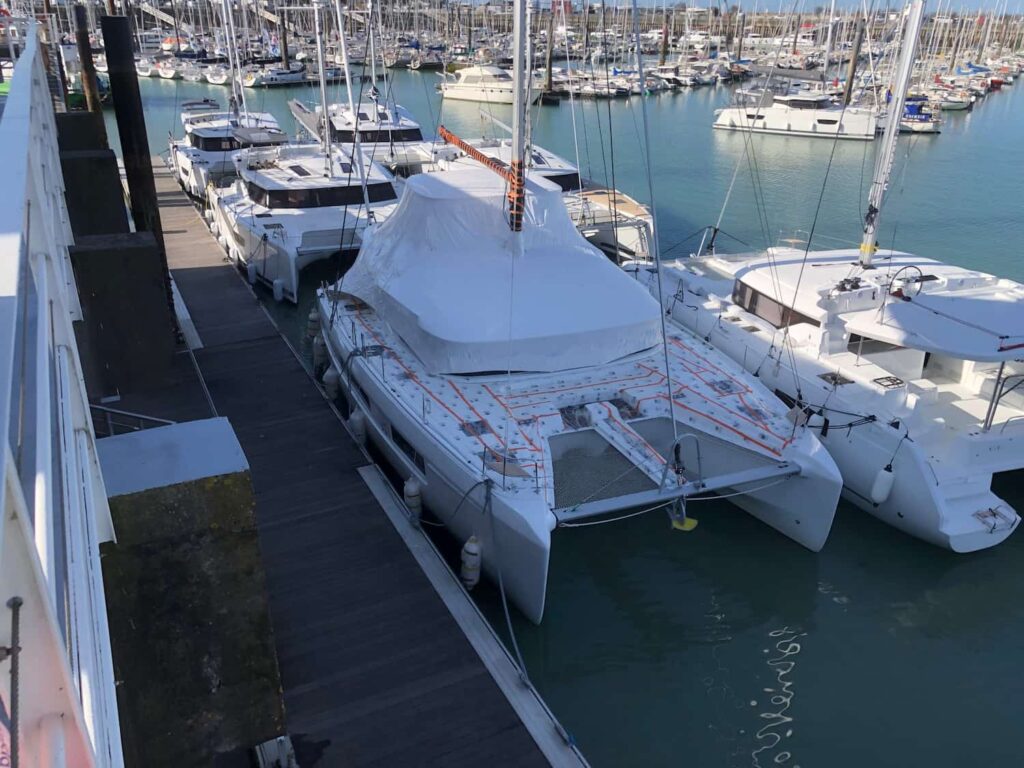
The next morning I lash down the dinghy while the crew takes on supplies. Later, we go out for a test sail in perfect weather. It is the weekend, and with the tide, dozens, if not hundreds, of yachts of all sizes are leaving the La Rochelle channel for the open sea. Groups of people sit together on board, as if in a Monet painting.
We hoist the mainsail, try out the reefs and test the autopilot and the other electronics. Everything seems to be working fine, including the way we work together.
The next day, the skipper team goes for another run, buys fresh bread and downloads all the weather information we need. The owner is already raring to go. At the fuel dock, however, we have a mishap. Anna and I are still reviewing the routing program for the voyage when we hear a splash. Apparently, Jochen had been pulling so hard on the fuel nozzle, which had jammed in the filler opening, that when it suddenly came free, he lost his balance and fell into the fast-flowing water behind the catamaran. Man overboard!! It takes us a second to grasp what has happened, but by then he has already grabbed the swim ladder and pulled himself back on board. What a start … A little shaken, we finish refueling. Jochen has bruised his sternum in the fall and complains of pain, but then waves it off, saying he will be all right.
Sunday, March 28, 2021
We pass Île de Ré to starboard, round Cape Oléron at sunset and set a west-southwest course towards Galicia. Getting out to sea is always a relief, even though there are still many unknowns ahead: 350 nautical miles across the Bay of Biscay, a good three days before we will be close to land again. Nobody can say whether or how well we will get along, or whether the new yacht’s systems will cooperate.
Jochen suggests sailing despite the light wind. A comment promptly arrives by satellite from our weather adviser Thomas. He monitors our track from his home office in Germany and writes:
“At that speed, it will take you 18 days to reach Lanzarote.”
Why not? That is what I think, at least.
The next day, a fresh southeasterly is blowing, accompanied by a three-meter swell from the northwest. Ideal conditions. The catamaran, by no means light and more like a house on runners, makes its way through the sea. We have completed our first maneuvers, the fishing line is out, and spirits are high. Lara, Jochen’s wife, is still a little uneasy with the swell and stays in her cabin. Anna is also feeling unwell. Jan, on the other hand, feels wonderful. Together we prepare a meal. The little Maltese dogs watch us, and the owner begins to relax.
The hours pass like this, but after a day the magic is over. The wind begins to weaken before dying away completely. Unfortunately, it is part of the job: start the engines and press on. This is not somewhere you want to spend long becalmed anyway.
On Tuesday morning we reach A Coruña. By phone, I have arranged the required service for the new engine with a specialist workshop. It looks as though it can be done before the Easter weekend. The Seca shipyard in A Coruña plans to send someone to the marina later. In the meantime, we visit this city again, a place both old and new, uniquely situated on the open Atlantic.
A Coruña
The Seca shipyard, which works only in its own marina, charges Jochen €650 for an oil change on the engines: roughly an hour’s work for two mechanics, plus materials, two filters and ten liters of oil. That is nothing short of modern-day highway robbery.
I chat with some Greeks berthed next to us on the deserted pontoon. They have picked up a Lagoon 50 in France, named Nana and registered in Mykonos. They too are waiting for the southerly wind to die down. The rest of their crew arrives that evening. We sit aboard our yacht drinking wine, while they do the same on theirs. In normal times we would surely have gotten together, exchanged stories and celebrated a little. The pandemic simply does not allow it. Everyone is minimizing the risk; nobody wants an outbreak on board.
Maundy Thursday, April 1, 2021
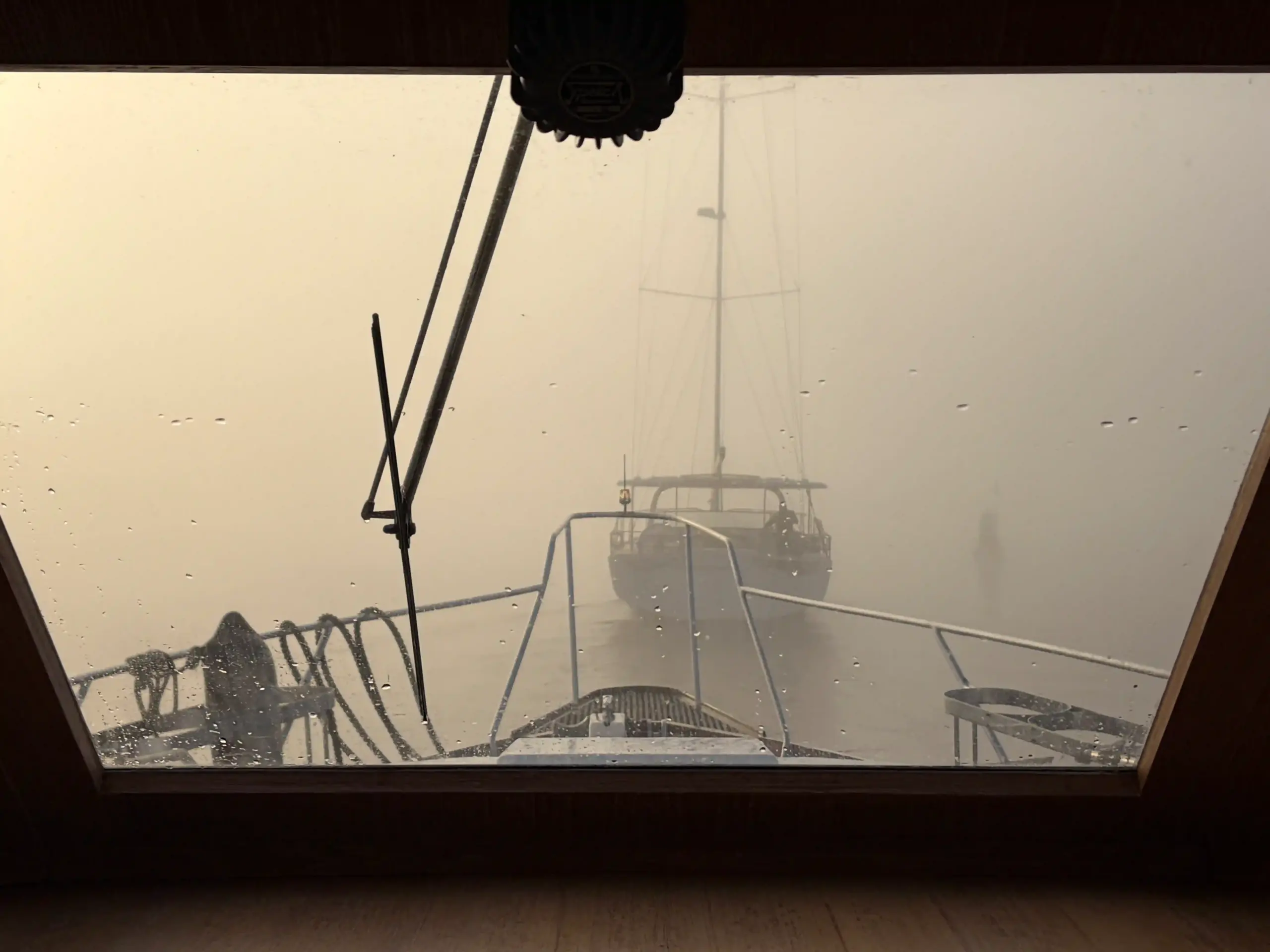
The next day, we take another dip in the cold water at Playa del Orzán and run a few errands. After a shower, we cast off. We motor around Cape Fisterre at night. The Greeks are closer to shore and half a knot faster. Then we encounter banks of fog.
By midday the next day, the sun gains the upper hand, although it remains hazy. I try to contact the Greeks by radio, and they respond. When I try to reply, the power supply to our radio fails. I try again, and this time it works, but my confidence in the equipment is gone. Fortunately, I have an inReach device and a handheld radio with me. I have experienced many equipment failures, particularly with radios.
Saturday, April 3, 2021
The calm is finally over. We sail south downwind on long tacks. For various reasons, our plan to sail straight through to Lanzarote gives way to a stop in Cascais. Our weather adviser advises against it too, but we do not want to miss the chance to go ashore before the long passage. We arrive on Easter Sunday. I ask the owner for a day in port. Anna and I take the bus to Sintra, whose hills rise to the north. The pandemic has its advantages too. The normally crowded town is deserted. We squeeze under a gate and climb up to a Moorish castle.
Easter Monday, April 5, 2021
The next day we initially motor south. The night is calm. Only shortly before Cape São Vicente do we set sail, and the sails will stay up for days. We pass east of the São Vicente traffic separation scheme and set a course of 200 degrees towards Lanzarote. There is less crossing traffic, and the wind cooperates: 12 to 16 knots from the northwest. We pick up speed. The catamaran is sailing as fast as it can, and we are making good progress.
The wind holds. The rhythm of the ocean, the swell, becomes second nature. The waves keep a steady beat as we race through the blue, under the stars at night, regretting only that we are not going all the way to Brazil.
We stand watch alone, with only Jochen’s wife excused. Of course, there are problems too: the radio, for example, really does have a fault. When you press the transmit button, the voltage drops and the unit cuts out. That is annoying, but not enough to spoil the enjoyment.
The new vessel, by no means a performance catamaran, sails beautifully. I make a rule that we have one proper meal a day, when everyone can sit at the table and look one another in the eye. With different watch schedules, a crew can otherwise drift apart all too easily.

At midday, I take a sun sight with the sextant while Anna learns the ropes. The process consists of three measurements: one before culmination, when the sun reaches its highest point, one at that moment and one afterwards. It keeps you busy for a good two hours, but then you have a position within 5 nautical miles of the GPS position. Old-fashioned, yes, but reassuring to know how to do it.
After two days we are abeam of Casablanca, about 150 nautical miles offshore. Portugal is 300 nautical miles away, and so is Lanzarote. An hour ago, over dinner, all seemed well. Now there is a knock at my cabin door. Lara says Jochen is not feeling well.
He reports chest pain and looks unwell. He had been quiet at dinner, which I had mistaken for contentment. He is the doctor, after all, and says he wants to get to a hospital as quickly as possible, just not in Morocco. Perhaps the fall in La Rochelle had caused more than just a bruise after all.
We had slowed down somewhat anyway, so we put the sails away and power ahead. As a precaution, I contact Bremen Rescue by satellite using the inReach and describe the situation. They write back and refer me to their telephone number. I am suddenly reminded of how serious things can become out here, so far from medical care. Before a voyage like this, we try to find out about our fellow sailors’ health using a questionnaire, but ultimately you have to be prepared for anything. Fortunately, we have people like Jan on board, who carries Tramal for such situations: a painkiller almost as potent as morphine.
Five days after leaving Cascais, we reach Marina Rubicón on Lanzarote. Jochen is feeling better. The dogs bark excitedly: finally, a chance to go ashore. The island is still in the midst of the pandemic; everything is open, but there are hardly any tourists. We take a day off and enjoy the warmth. Then the owners take us to the airport in Arrecife: we are heading on to Sardinia. On to the next job …

Share this blog -
Subscribe to our newsletter to receive the latest blogs & stories from Yachtskipper.eu
interesting blogs