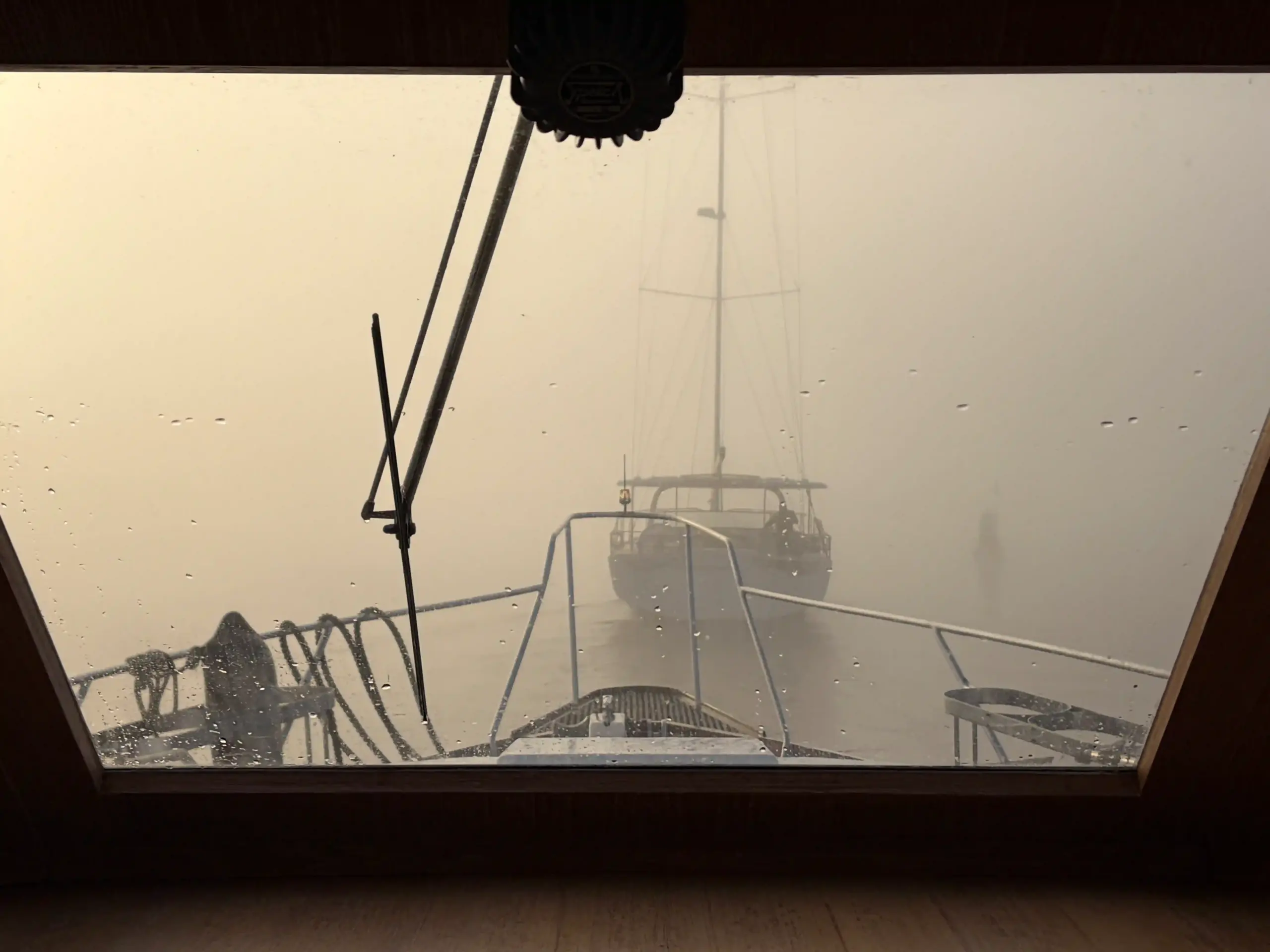
Across the Atlantic on the CNB 86 – 4,250 Nautical Miles from Newport to Marseille
By Rainer Holtorff
Delivering a small superyacht across the Atlantic with just over a week’s notice certainly adds excitement to life. From Newport to Marseille, 4,250 nautical miles lay ahead of us. This is how the voyage unfolded.
Handover in Rhode Island
Wednesday, June 15
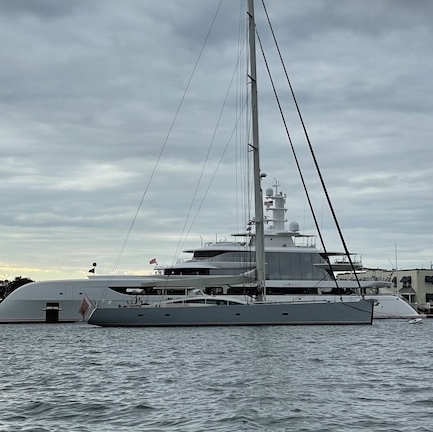
The advance party of our five-person crew flew to Massachusetts first: Niklas, Stephan and I. From Boston Logan, we took an Uber to Portsmouth, Rhode Island. Between Hinckley’s Boatyard and Dyers Island, the CNB 86 “Capricho II” was the only yacht anchored in the darkness.
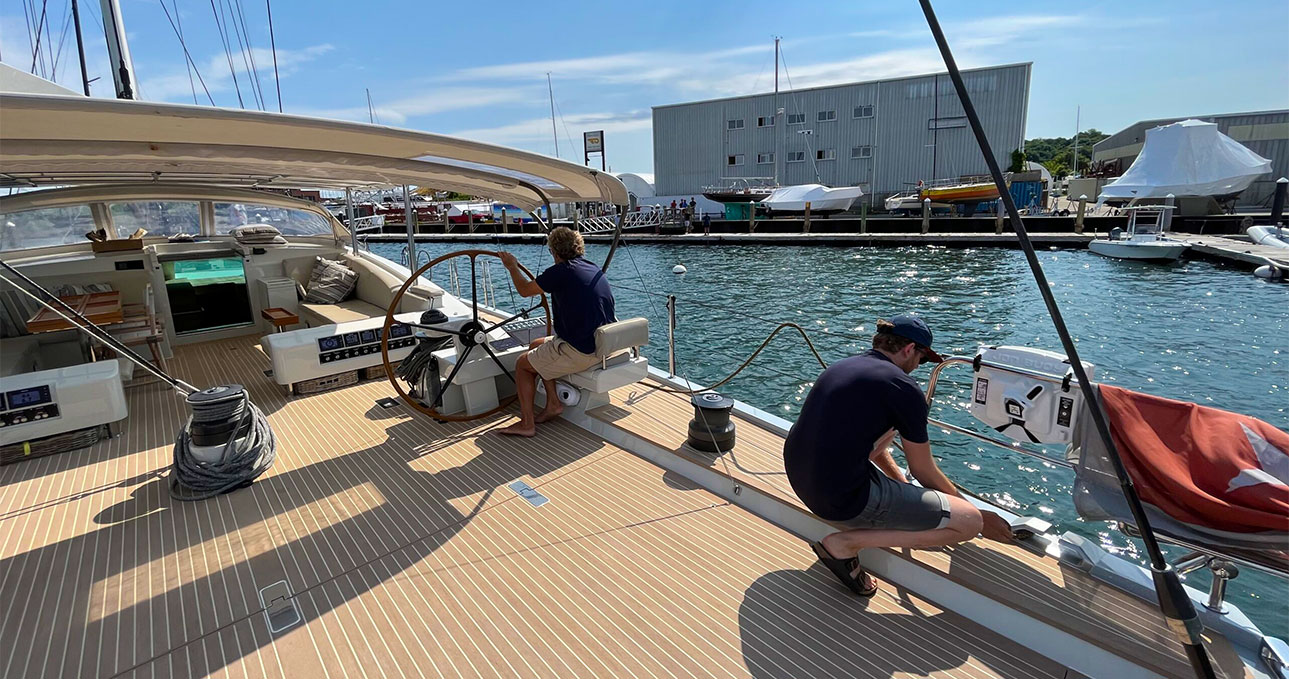
Nikolaj, the owner, a friendly Dane, was waiting for us on board. He began briefing us early the next morning. By noon, he had to leave for his flight to Europe. We tried to remember everything he told us about the complex systems and kept a camera rolling just in case. Before he left, we went over to the boatyard together to take on diesel and water. The fuel dock attendant told us he had lived in Palma for many years as captain of a racing yacht owned by Hasso Plattner. When we mentioned the approaching low and said we would prefer to be alongside, he launched into his broadest American slang:
“You want dockspace?!? I can get you dockspace! Just let me make some phone calls!!”
While the diesel flowed into the tank, he made his calls. From time to time, he called over to say he hadn’t found anything yet, but he had a few more numbers to try. In Newport, for example.
“But that costs $1,000 a night for an 86-footer!” our owner interjected.
“O.k. – so you don’t want that – I can also find you space for free! You just have to make a donation!”
In the end, we remained the only yacht anchored outside the harbor. The owner had left, and the low was approaching, bringing wind, rain and thunderstorms. If the anchor dragged, we would first have to start the generator, bow thruster, hydraulics and main engine. Only then could we retrieve the chain. In windy conditions, radio is the best way to communicate on a vessel this size. Nothing happens quickly here.
Thursday, June 16
We read manuals, tried things out and reset the anchor after a thunderstorm. Even away from Newport, there was plenty going on. At the boatyard, several crews were preparing feverishly for the Newport–Bermuda Race, a 630-nautical-mile offshore race.
That evening, Brandon, Niklas’s host brother from his time as an exchange student, came by. At the only restaurant for miles around, we ate lobster rolls at a camping table. $145 for a snack! I added a ten-dollar tip. The waitress, who had been in excellent spirits just moments before, asked:
“Was there anything not right with the service??!”
Brandon explained that I was European and apparently unfamiliar with the local customs. I immediately added to the tip.
Nicola and Michael arrived that evening, completing the crew. Nicola, a Lufthansa purser until the beginning of the year, had already sailed across the Pacific and had recently sailed through the Mediterranean with us. Michael, a dentist in active retirement, had set out with me from Rhode Island toward Europe three years earlier, that time on a catamaran.
Anchors Aweigh!
Together, we got the yacht ready and moved her ten nautical miles to a mooring buoy in Newport. We got to know one another and stocked up on provisions for up to four weeks. We did not yet know whether we would call at the Azores, so our supplies had to last as far as mainland Europe. Michael and I still knew the supermarkets and chandlers from our last visit. On board, we continued familiarizing ourselves with the systems and consulted the owner in Copenhagen when necessary.
Monday, June 20
Half a week after our arrival, we cast off and sailed out of Narragansett Bay. We had originally planned a trial sail to Martha’s Vineyard. With a storm system expected off the coast, we decided to head east straight away and continue getting to know the yacht underway.
We carefully hoisted the mainsail for the first time. With a 40-meter mast, small mistakes can have serious consequences. Everything went well. Soon we had settled into our watch schedule, Nantucket disappeared into the distance, and the first of many nights lay ahead. As skipper, I was off watch. I remember simply collapsing from exhaustion. The previous few days had been demanding.
That evening, we noticed that the autopilot was not holding course. Each time we restarted it, it worked for a while, then beeped and failed again. We checked the steering, reset the system and consulted the manual. After midnight, I realized we were unlikely to solve the problem on board. Hadn’t the owner also mentioned a leaking rudder shaft, right where the autopilot drive was located? I turned us around. We were already 75 nautical miles offshore. The prospect of hand-steering this yacht for thousands of miles was not appealing.
Stephan came on deck for his watch and began setting out the offshore fishing gear. I asked him if he had nothing else to worry about. He looked at me in surprise. I pointed to the compass. Only then did he notice that we were heading west.
We contacted the owner by satellite. When the autopilot drive made no sound even with a direct power supply, it was clear we needed a replacement. Nikolaj promised to send a new drive to Newport as quickly as possible. Meanwhile, we had been motoring for hours, and the display showed that the fully charged lithium-ion batteries were getting warmer and warmer. We had already put a large pot of water on to use some electricity when Nikolaj contacted us by satellite. There was a retrofitted switch that could disconnect the charging current. It had not been mentioned during the brief handover.
After 29 hours, we reached the mooring field off Newport again. Fortunately, our buoy off Goat Island Marina was still free, and two harbor staff helped us tie up. As soon as we were safely secured, we fell into a deep sleep.
Nikolaj wrote that the replacement drive would not arrive for a few days. We settled in for a few days on the buoy. For people who enjoy watching boats, there are worse places. In Newport, beautiful vessels sail past, and their crews wave to you.
Waiting for a Replacement
While we were waiting in Newport for the replacement part, there was a case of COVID on board. Michael took charge of arrangements as our onboard doctor. We were glad to be on the buoy at the time rather than 400 or 500 nautical miles out at sea.
The new drive finally arrived at Safe Harbor Marina. Stephan, our chief engineer, set about installing it with Niklas. They had to partially dismantle the port rudder steering system, connect the drive’s sprocket to the steering chain, retension the chain and connect the drive to the 24-volt electrical system.
By noon the next day, everything was ready. We waited another two days before the next test.
Second Attempt
Sunday, June 26
Around noon, we left Newport for the second time. South of Martha’s Vineyard and Nantucket, we reached the open sea in a fresh breeze. We tested the sails and reefs and made good progress eastward. The fishing trawlers became fewer, until only the occasional freighter crossed our path. We still had fish, though. During the first few days, we caught a yellowfin tuna that filled the refrigerator.
June 30 · 400 Nautical Miles East of the Mainland
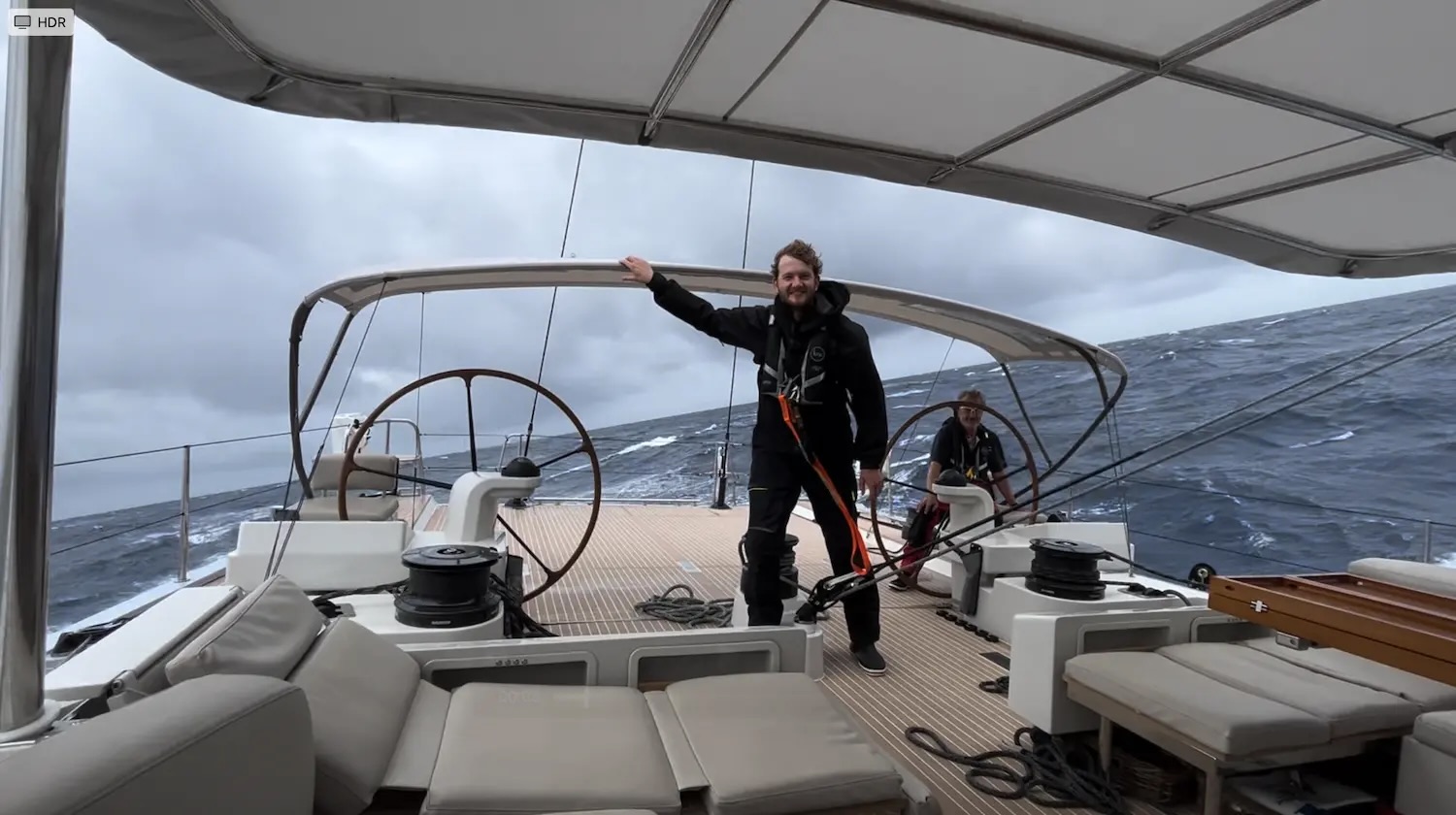
We were trying to “ride” the Gulf Stream when the edge of a low reached us. The wind shifted southwest and increased to over 30 knots. The yacht rumbled down the waves at ten or eleven knots. We were amazed at how much we could feel the sea even on a vessel this size. In the rough conditions, we headed into the wind and waves for the first time to put in the third reef. The enormous boom had to remain under tension throughout, or it would slam.
The strong wind lasted all day. After dark, the front passed through. Lightning flashed and rain poured down. Behind it, showers alternated with sunshine. By the next morning, the wind had gone, but the waves continued. The heavy vessel rolled from side to side like a pleasure steamer. It took another day for the sea to calm. I thought of our Uber driver in Newport. When we had told him about the crossing, he had murmured, “The sea knows no mercy.” A sailor I had met in Newport had gone overboard out here during a delivery the previous year and had not been found despite an extensive search. We later also heard about a damaged CNB 66. We had taken a cautious approach from the start. The owner had entrusted us with a well-equipped and well-maintained yacht, and we wanted to bring her safely to France.
A Jammed Halyard in Mid-Atlantic
Early July · 40° 15′ N, 46° 59′ W
That morning, it looked as though there would be little wind. The day before, Stephan and I had examined the huge carbon boom and considered whether we could use it to pole out the genoa. Today, it was the gennaker’s turn. If we were going to need it soon, we wanted at least to have rigged and tested it beforehand.
All hands on deck. We brought the furled sail out of the forepeak, attached it to the spinnaker halyard, secured the sheet and furler, and winched the head of the sail up to the masthead. Then we unfurled the great blue sail.
The wind soon died. The gennaker billowed in the swell and no longer filled. We wanted to furl and lower it again.
The halyard gave way by a meter. With more pulling, it moved a little farther, then stopped. Even with our combined strength and the winch, nothing moved. We ruled out leaving the furled gennaker hoisted all the way to the Azores. It would have been too dangerous if the wind picked up. The next port was still 800 nautical miles away.
So someone had to go aloft. Stephan volunteered. He calmly prepared the bosun’s chair, packed some tools and got the headsets working. Around noon, we began winching him up the 40-meter carbon mast.
There was no wind, and only an occasional swell rolled through. I tried to keep the bow into the waves. Even so, the mast swung. Stephan secured himself with straps before and after each set of spreaders so that the movement would not throw him around. The headsets failed, and he had no hand free for the handheld radio. It took him over half an hour just to get from the second to the fourth set of spreaders. I wondered how long his strength would last.
Michael and Niklas operated the winch for the main halyard on which Stephan was suspended. Nicola tended the genoa halyard as a safety line. I continued trying to keep the yacht aligned. After what felt like an eternity, Stephan reached the top. We could only guess what he was doing up there. When we called to him, he replied quietly that shouting back was exhausting him. What if he lost consciousness up there? What if an auxiliary line became tangled so badly that we could no longer use the genoa either? The others tried to reassure me. I watched the clouds gather and thought of the forecast wind. Stephan had already been up there for over an hour.
Nicola, Niklas and Michael remained at their stations in the blazing sun. They watched for every signal from Stephan and hauled in or eased the lines accordingly.
After several attempts, Stephan managed to attach the jammed sail to another halyard. We lowered it and laid it on deck. Then he began his descent, again secured to the mast with straps. On the swaying mast, there was barely anything he could hold on to.
Half an hour later, he was back on deck with trembling knees. I was relieved, grateful and proud of this mixed group of people who had worked together with such concentration for hours.
Flores, Horta and Ponta Delgada
July 8
We had made good progress for days. Moderate southerly winds brought warmth and good daily runs. Around 150 nautical miles from the first island in the Azores, we encountered a ridge of high pressure, and the wind died. While lowering the mainsail, we noticed a broken mast slide. We planned to replace it off Flores.
After so many days at sea, seeing land is a strange feeling. From a distance, Flores looked like a lump in the sea. Closer to the island, we could make out green valleys, waterfalls and terraced fields.
We entered a bay and let the yacht drift while we replaced the damaged mast slide. To do so, we had to lift the flaked mainsail. When we examined the part we had removed, we were astonished. The stainless-steel screws looked as though they had been worked on with a welder, and the plastic had melted. Could it have been lightning? The owner had mentioned a severe thunderstorm before our arrival.
That afternoon, we set course for Horta. With northeasterly winds of up to 20 knots, the passage to this mecca for Atlantic sailors should have been easy. During the night, however, calms alternated with strong winds. We wanted to make progress and had the first reef in the mainsail. In the lulls, that was too little sail; in the gusts, too much. By morning, we were exhausted. I must have been on deck eight times during the night.
When Faial came into view, our anticipation grew with every mile. The strong northeasterly wind was blowing straight into Horta harbor. As we approached, we saw that the harbor was overcrowded and there was no room to anchor. No one answered our radio call. With a heavy heart, I decided to use the north wind and sail on to Ponta Delgada. Another 150 nautical miles. We had all been looking forward to Horta.
By evening, the channel between Pico and São Jorge was astern. The night was dark and windy. We sailed with the second reef in. Gusts kept coming, but it was better than the night before.
Toward morning, the green slopes of São Miguel came into view. We sailed along the coast for a while, then lowered the mainsail and entered Ponta Delgada marina. Once again, no one answered on the radio. We raised the hydraulic keel and edged cautiously into the only berth suitable for a yacht our size, directly behind a Hylas 70. Her skipper took our stern line. Once we were secured, the tension fell away. The swimming facility, cafés and restaurants were just around the corner. I felt euphoric all day.
From the Azores to Gibraltar
July 16 · 38° 24′ N, 19° 03′ W · Two Days at Sea
We stayed in Ponta Delgada for four days. Fortunately, a low east of the Azores kept us in port longer. We went swimming, wandered through town, met new people and visited Birgit and her children. Before casting off, we painted our voyage mural on the harbor wall. According to an unwritten rule among Atlantic sailors, it is part of preparing for the next leg.
We sailed out, lowered the keel and set the mainsail with the second reef in. In gusty northerly winds, we sailed along the coast to the eastern end of São Miguel. The low had meanwhile moved north and was expected to bring us northerly winds, followed by westerlies, on the way to Gibraltar. PredictWind suggested sailing northwest to the 39th parallel first, then turning southeast onto port tack after about a day and a half. For the time being, this meant heading toward the center of the low, with clouds, poor visibility, gusts and rain.
On the second day, we tacked. On this yacht, that takes three people. We took up the running backstay, released the preventer and furled the genoa. The new leeward sheet had to be led around the staysail halyard. Then we came through the wind, set the preventer on the new tack and unfurled the genoa together.
July 20, 2022 · 100 Nautical Miles West of Gibraltar
After the low between the Azores and the mainland, there was a brief calm. Then the Portuguese northerly wind set in. At the traffic separation scheme off Cabo de São Vicente, winds reached 30 knots and waves three meters. There was plenty of power in the sails again. As we entered the Strait of Gibraltar, we tried not to think too much about orcas. In moderate visibility, we reached the anchorage off La Línea in the middle of the night. We were back on the European mainland.
On to Marseille
The delivery was not over in La Línea. We had promised to take the yacht to France. Soon we weighed anchor again and sailed to a bay west of Barcelona. There we jumped into the warm Mediterranean. When the mistral eased the next day, we set out on the final 150 nautical miles to Marseille.
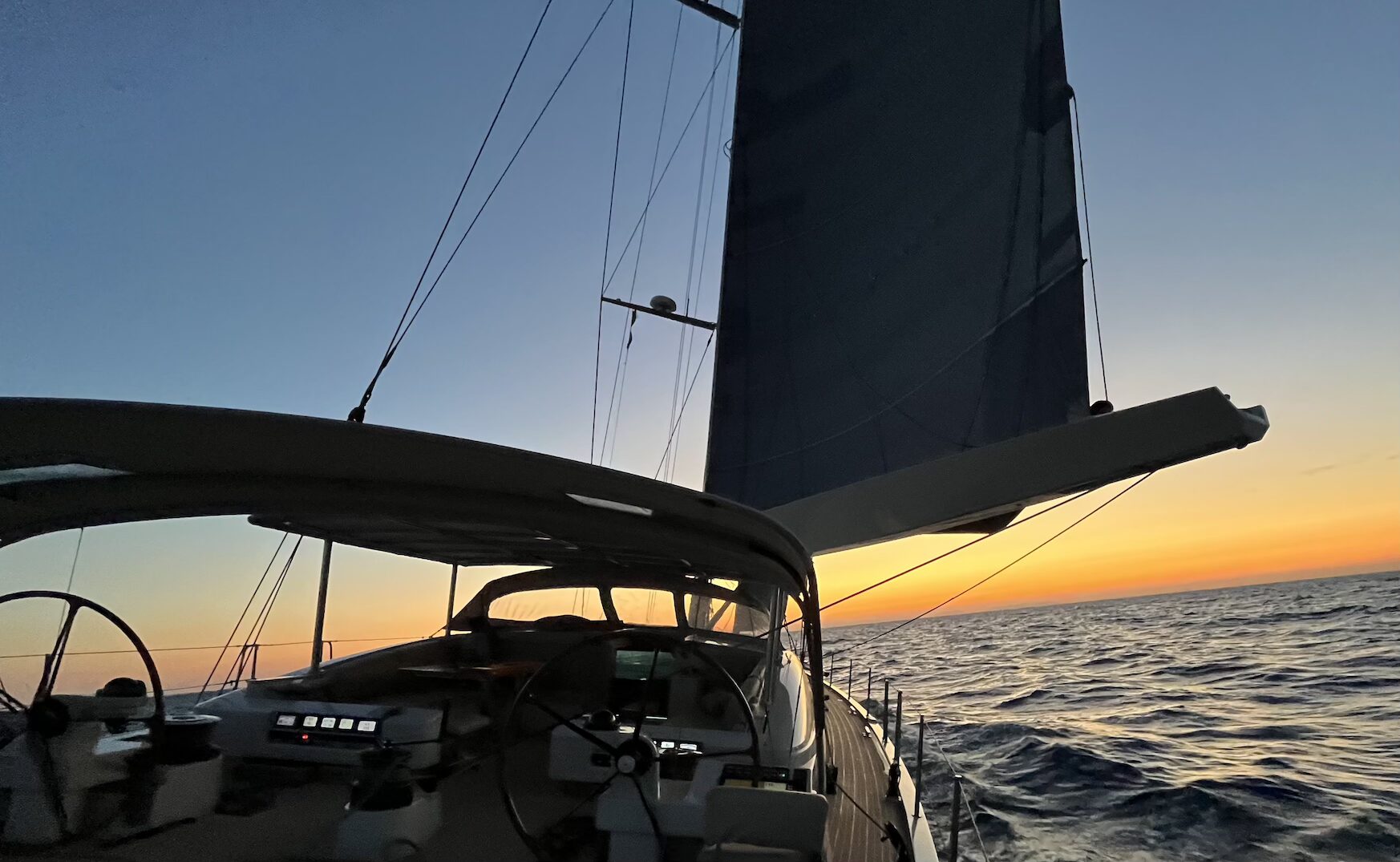
On our final night in the Gulf of Lion, we already knew we would miss this vessel. That particular night was especially beautiful. After the brief handover, we had spent 4,250 nautical miles steadily learning more about the systems and how to handle the yacht. And we had grown together as a crew.
At noon, we entered Marseille. The harbor master’s boat led us to our berth directly in front of City Hall. Soon we had tidied up, and our sea bags were on deck. When Nikolaj saw his yacht again, he looked incredulous for a moment. Then he stood there in front of the “Capricho II,” safely arrived after 4,250 nautical miles.
Yacht: CNB 86, built in 2009, sloop with a hydraulic lifting keel (draft 2 to 4 meters).
Share this blog -
Subscribe to our newsletter to receive the latest blogs & stories from Yachtskipper.eu
interesting blogs